
That Silly Cert Stamp
A BMC, or cert stamp, is a guarantee by whoever produced the item or certifying organization that it will meet certain standards, so that the trucking company (carrier) will accept liability for any damage that might occur to the product in transit. The NMFTA, the organization that “owns” the stamp and designates its rules, have created minimum standards for boxes to make sure their contents go undamaged in the LTL (less than truckload) shipping environment. The standards can be found in Item 222 (or Rule 41) of the NMFTA classification.
In many situations a cert stamp is not required! An example is when shipping truckload quantities on your own trucks, not at all necessary. When shipping individual boxes via Fedex/UPS/USPS it is not necessary as they have different rules. This is why you see rectangle cert stamps on more and more boxes these days, or not at all.
A cert stamp is not a guarantee of actual results or performance. The freight rules specify that to meet the requirement, 5 out of 6 tests must meet/exceed the value indicated with the 6th no more than 10% below the indicated value. This testing must also be done in very specific testing environments (lab setting) that no box manufacturer can do at their production locations.
A cert stamp does not guarantee a board grade or what combinations of paper were used.
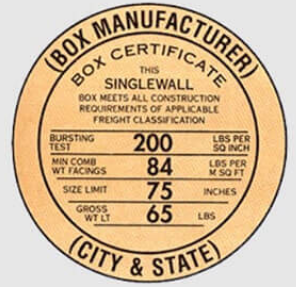
Knowing what I know from my extensive industry experience and knowledge, if I were a buyer of corrugated products, I would insist that my box supplier not put any cert stamps on any corrugated items they produce for me for a few reasons.
It does not accurately guarantee performance of the box
In the majority of cases it is not needed
I don’t need anyone knowing what manufacturer or location is producing items for my company
It is not the best indicator of performance, I will get to that in another post/article
Cert stamps are not apples to apples between various suppliers, it is really apples to oranges
There is absolutely no law or government agency rule requiring that you print a cert on any box unless it is a hazardous product or the box is being sold to the government.
As a buyer, ask your company the last time you went back to any trucking company for damage during LTL transit, it is the only time you really need that cert stamp. Technically, using a cert to overstate a box’s compliance is technically fraud under the Uniform Commercial Code (UCC).
Corrugated boxes should be sourced for the entire distribution process, not just the time it is on a truck (although that is important). Performance based packaging and board grades should be utilized and that is not what is found on any cert stamp. If you quote items based on cert stamps or board combinations, you are sending money down the drain and not getting the best “box” for your entire distribution environment.
As much as any other box nerd, I love flipping over boxes in the retail environment to see where they were produced and by which company. I also know that it is an antiquated means of guaranteeing performance and we need to move into the 21st century. Don’t get me started on Mullen, again a topic for another post/article!
The cert stamp is so misconstrued, every box does not need one (most don’t), no one will ever get sent to jail if it is missing or incorrect, and it really isn’t helpful to signify the strength or composition of the box.
