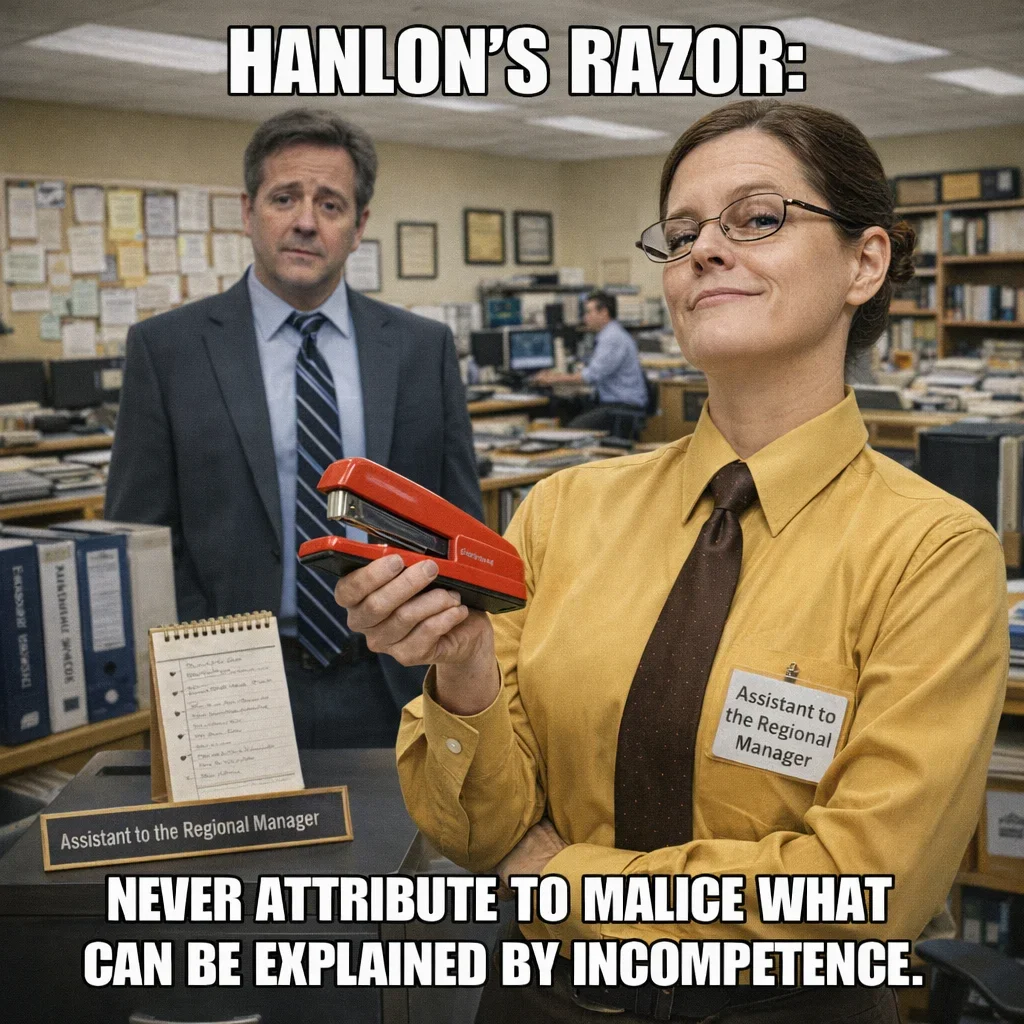
Hanlon’s Razor
Hanlon's Razor is an adage or rule of thumb that suggests:
"Never attribute to malice that which is adequately explained by stupidity."
Essentially, it encourages you to avoid assuming that someone acted with bad intentions when a simpler explanation—like a mistake, ignorance, or lack of attention—is just as likely. It is a philosophical tool used to eliminate unlikely explanations for human behavior, much like Occam's Razor suggests choosing the simplest explanation when faced with competing hypotheses.
Some key points about Hanlon's Razor include:
Communication and Relationships: It is often cited as a way to maintain better relationships and reduce conflict. By assuming a person made a blunder rather than a calculated attack, you can respond with patience or helpfulness instead of hostility.
Cognitive Biases: It acts as a check against the "fundamental attribution error," which is the human tendency to over-emphasize personal intent rather than situational factors when judging others' actions.
Origin: While the sentiment has existed for centuries in various forms (including writings by Goethe), the specific phrasing was popularized by Robert J. Hanlon in the 1980s for a book of jokes and adages.
Limitations: It is not a universal truth. Sometimes people do act with malice, but the "razor" serves as a starting point to prevent paranoia and emotional overreaction in everyday life.